
Arader Galleries
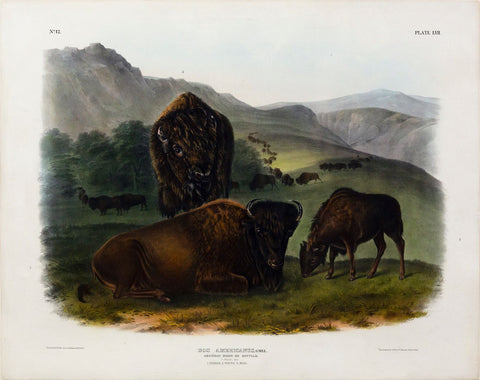
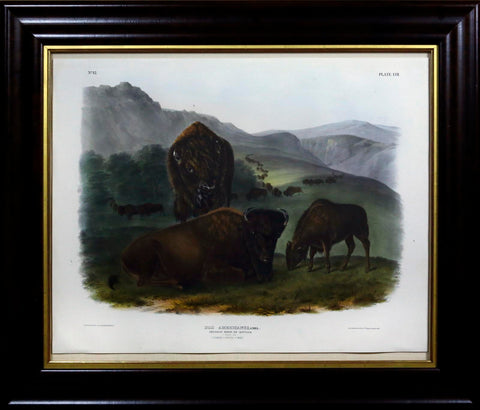
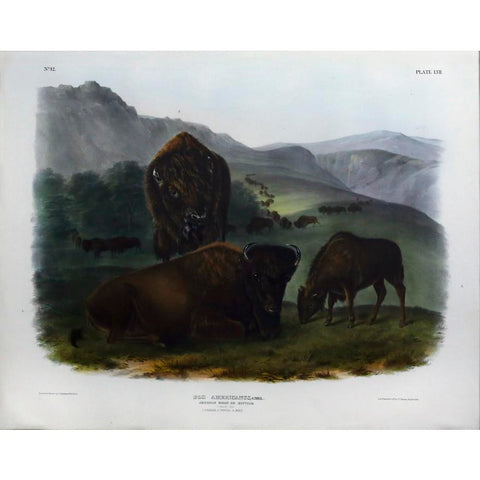
John James Audubon. Buffalo, Female with young. 1845.
$ 18,000.00
Pickup currently unavailable
AUDUBON, John James (1785-1851).
American Bison or Buffalo (Female, Young & Male), Plate 57.
Lithograph with original hand color.
New York: Bowen, 1845-1848.
Viviparous Quadrupeds of North America, Imperial Folio First Edition.
21 7/8" x 28" sheet.
Comparables: Arader Galleries, 2019 - $20,00;
State Animal of Kansas, Oklahoma, and Wyoming.
A commanding first edition lithograph from John James Audubon’s monumental Viviparous Quadrupeds of North America, recognized as the most ambitious and beautifully produced American natural history colorplate work of the nineteenth century and the first of its scale executed entirely in the United States.
Plate 57 presents the American Bison in a complete family group, bull, cow, and calf, arranged with both scientific clarity and emotional presence. The massive bull anchors the composition with extraordinary detailing of fur and musculature, while the female and young introduce movement and tenderness, transforming the subject from specimen into living creature. The surrounding prairie landscape conveys space, air, and the openness of the western plains with a painterly richness achieved through the master lithography of J.T. Bowen.
The result stands among the most iconic wildlife images produced in America, combining monumentality, naturalism, and narrative in equal measure.
Historical Context
Following the success of The Birds of America, Audubon turned to North American mammals in collaboration with the Reverend John Bachman. Together they undertook extensive travel and firsthand field observation, determined to document the continent’s fauna with the same authority and scale that defined the earlier bird folio.
Published between 1845 and 1848, The Viviparous Quadrupeds of North America represents a landmark in American printmaking. Unlike the Havell engravings of the Birds, the Quadrupeds were produced as lithographs, allowing for greater tonal depth and a softer, more painterly modeling. The project demonstrated that American workshops could equal and often surpass European production in technical and artistic sophistication.
The Buffalo in America
At the time this plate was prepared, the American buffalo still embodied the scale and vitality of the continent itself.
For centuries, immense herds shaped the ecology of the Great Plains, their migrations maintaining the grasslands and supporting a vast network of wildlife. For Indigenous nations, the animal formed the center of daily life, providing food, shelter, clothing, and ceremony in a balanced and sustainable relationship that endured for generations.
Even in the early nineteenth century, observers described herds numbering in the millions, stretching to the horizon in continuous motion. The species once ranged from the eastern woodlands to the Rocky Mountains and from Canada into northern Mexico.
Audubon worked at the last moment when this abundance still defined the western landscape. Steamboat travelers on the Missouri River reported thousands along the banks, and military expeditions recorded migrations that darkened the plains with dust and movement.
Within only a few decades of publication, however, industrial hide hunting, expanding railroads, and westward settlement brought rapid and dramatic decline. By the late nineteenth century, the population had fallen from tens of millions to only a few hundred survivors.
This image therefore preserves more than a species. It preserves a world.
Audubon’s buffalo stands as a document of the American frontier before collapse, a portrait of the animal in its full strength and dignity, recorded at the precise historical moment when it still ruled the plains.
Significance
This plate embodies the defining qualities that distinguish the greatest Audubon works:
• Large scale artistic presence
• Scientific accuracy based on direct observation
• Exceptional American lithographic craftsmanship
• Profound historical and environmental resonance
Few natural history images carry such symbolic and cultural weight. The American bison remains an enduring emblem of the nation and today serves as the official state animal of Kansas, Oklahoma, and Wyoming. Within Audubon’s Quadrupeds, it stands among the most sought after and recognizable subjects.
References
Audubon & Bachman, Viviparous Quadrupeds of North America, Imperial Folio Edition
Nissen ZBI 163
Ford, Audubon’s Animals
Sitwell, Fine Bird Books